At TIGEM, biologists, bioinformaticians and statisticians combine data, computational models and laboratory research to advance rare disease science.
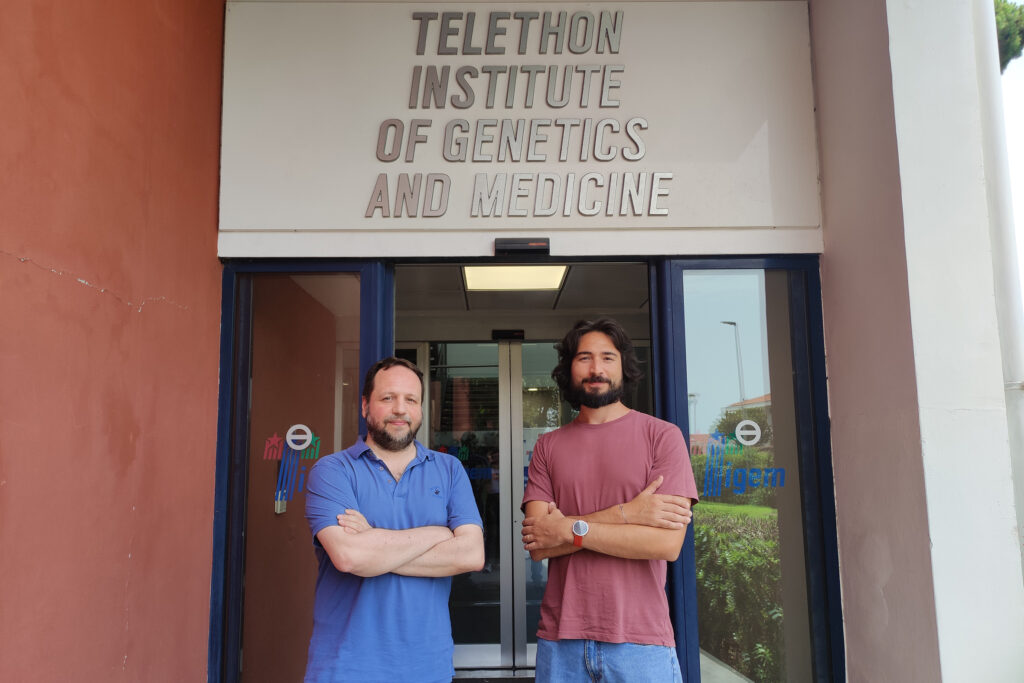
At TIGEM, experimental biologists, bioinformaticians, statisticians, engineers and specialists in molecular modelling work side by side on scientific questions related to rare genetic diseases. The computational component is neither a separate stage nor a purely technical service: it contributes directly to hypothesis generation, experimental design and the interpretation of results.
The career paths of Andrea Pasquadibisceglie, Project Leader with expertise in structural and computational biology, and Eugenio Del Prete, Facility Staff member of the Bioinformatics Core specialising in biostatistics and bioinformatics, illustrate two different routes towards this point of convergence.
Two paths towards interdisciplinary research
Eugenio Del Prete began his professional career as a telecommunications engineer. During his thesis, he started applying statistics and data analysis to biology, before continuing with research experience at CNR-ISA (Institute of Food Sciences), where he worked on the analysis of protein families and the development of tools for analysing mass spectrometry data. His desire to gain a deeper understanding of biological questions later led him to undertake a PhD in applied biology, with a particular focus on coeliac disease.
“Coming from an information technology background, I wanted to understand why certain methods were being applied, rather than simply carrying out the analyses without knowing the underlying biology” he explains. After a postdoctoral position at CNR-IAC (Institute of Applied Mathematics), focused on the application of statistical methods and the development of tools for omics data analysis, Del Prete joined TIGEM, where he now works across biostatistics, bioinformatics and data analysis.
Andrea Pasquadibisceglie followed an almost opposite path. After training in biology, he became interested in protein structure and in the possibility of studying it through computational tools. During his PhD, he learned programming and deepened his knowledge of statistical mechanics and molecular dynamics, progressively bridging the gap between his biological training and quantitative skills.
“For a biologist, acquiring a background in data science and mathematics is not straightforward. It was a challenge for me, but it was also what interested me, so I was happy to take it on” he explains. After a postdoctoral experience in Stockholm with an international group specialising in the computational study of membrane proteins, he joined TIGEM in 2025 to work on protein design projects.
Their experiences show that an interdisciplinary profile can be built from opposite starting points: from data science towards biology, or from biology towards data science.
From simulations to experimental validation
Pasquadibisceglie’s main project focuses on designing enzymes with higher activity than the original proteins. His work combines molecular dynamics, computational models and artificial intelligence tools to identify variants with potential therapeutic relevance.
A typical day may begin by checking the progress of previously launched simulations, identifying any errors and analysing the results they have produced. Once the predictions reach a sufficient level of reliability, the work continues in collaboration with the experimental groups, which can test them in the laboratory.
“A fundamental part of the work is engaging with the experimental group, explaining what has been done and clarifying how the data should be interpreted” Pasquadibisceglie says.
In this process, computational and experimental approaches continuously inform each other. Predictions help guide laboratory testing, while experimental results can subsequently be fed back into the models to select new variants for investigation with greater accuracy. The aim is not to develop technology for its own sake, but to gain a deeper understanding of molecular mechanisms and contribute to improving potential therapeutic strategies.
The Bioinformatics Core as a point of connection
Eugenio Del Prete’s work offers a more cross-cutting perspective. The Bioinformatics Core collaborates with TIGEM’s different research groups and brings together complementary expertise in biology, statistics, omics data analysis and the management of computing infrastructure.
The process always begins with a scientific question. After an initial meeting with the research group involved, the Bioinformatics Core helps define the problem, identify the most appropriate approach, carry out the analyses and discuss the results. Its contribution therefore goes far beyond simply providing numbers or plots.
“We support research not only through data analysis, but also by helping to interpret the results” Del Prete explains.
The applications can vary considerably. Some projects involve large genomic datasets, in which even a small number of samples can generate substantial amounts of data. In other cases, the volume of data is more limited, but a high performance computing infrastructure is still required to run simulations or generate complex models quickly.
Computational approaches can also help in identifying the most promising candidates for experimental validation, among thousands of drugs, vectors or molecules. Narrowing down the range of possibilities makes research more targeted, while saving both time and resources.
Learning to speak different languages
Interdisciplinary collaboration also requires the ability to communicate effectively. Those who work with models and data need to understand the biological meaning of the questions being addressed, while those carrying out experiments need at least the basic tools required to interpret statistical analyses and computational results.
For this reason, the Bioinformatics Core also provides training and mentoring. It organises internal courses on statistics, machine learning and emerging technologies, supports PhD students and early-career researchers, and helps them in developing greater independence in analysing their own data.
TIGEM can therefore welcome both researchers who already have a computational background and want to move closer to biology, and those coming from the life sciences who wish to acquire quantitative skills. A PhD is one of the most structured routes into this field, but it is not the only possible entry point.
Why choose TIGEM
For Pasquadibisceglie, one of the institute’s most distinctive features is the opportunity to observe and engage with the entire research pipeline, from understanding molecular mechanisms to experimental validation and, ultimately, translational and clinical perspectives.
“There are very few institutes that offer the opportunity to conduct such multidisciplinary research. Here, we can start from basic research, apply computational methods, move on to experimental validation and collaborate with experts involved in the different stages of the process” he says.
This is complemented by the opportunities for professional growth created through daily interaction with people from different disciplines. For a bioinformatician, statistician or computational biologist, working at TIGEM means applying their expertise to real scientific problems, complex datasets and research with the potential to improve patients’ lives.
As Del Prete points out, motivation also comes from knowing that one’s contribution is part of a shared goal: “You know that your efforts are serving something genuinely important, something that moves from research all the way to patients”.
At TIGEM, it is precisely through the meeting of biology, data, models and laboratory research that rare disease research takes shape.
